
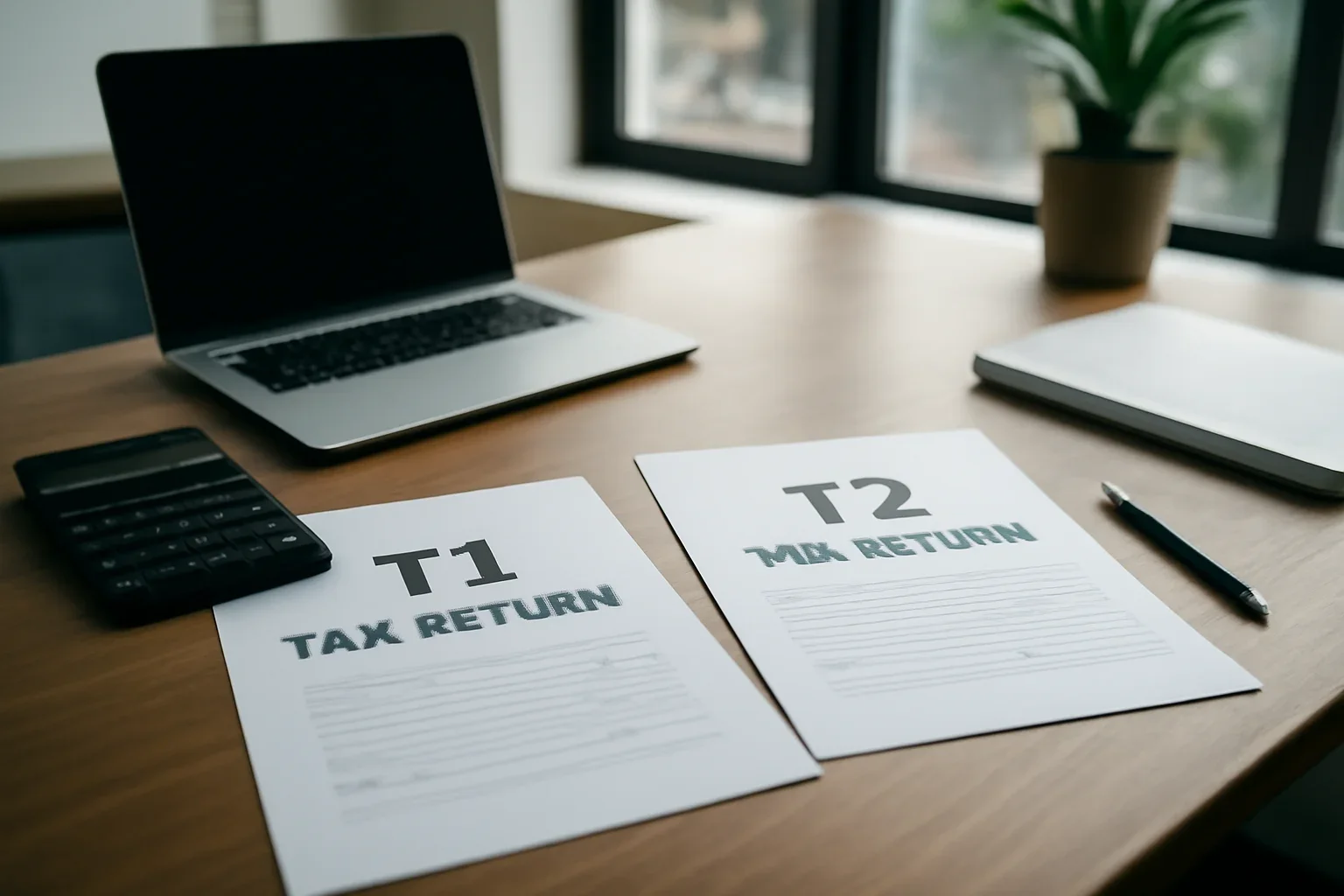
T1 vs T2: The Simplest Difference Is Individual vs Corporation
The easiest way to understand a T1 versus a T2 return is to identify who earned the income.
A T1 Income Tax and Benefit Return is used for an individual's personal tax filing. If you are self-employed or operate a sole proprietorship, your business activity is generally reported as part of your personal return rather than through a separate corporate T2 return.
A T2 Corporation Income Tax Return is used by corporations that have their own corporate tax-reporting obligations.
T1 Return
- Individual income tax return.
- Used for personal tax reporting.
- Can include self-employment or sole-proprietorship business activity.
- Business information may be reported through supporting schedules such as the T2125 where applicable.
- Personal income and applicable credits or deductions are part of the return.
T2 Return
- Corporate income tax return.
- Filed separately from the shareholder's personal return.
- Reports the corporation's income and tax information.
- Uses corporate financial and tax information.
- Corporate year-end determines the filing period.
What Is a T1 Tax Return?
The T1 Income Tax and Benefit Return is the primary personal income tax return for individuals in Canada.
Depending on the individual, a T1 may include employment income, investment income, pension income, rental income, capital gains, self-employment income, and other amounts that need to be reported for the year.
The exact schedules and supporting forms depend on the person's circumstances.
Self-Employed Does Not Automatically Mean T2
This is one of the most important distinctions for small business owners.
Being a freelancer, contractor, consultant, or sole proprietor does not by itself mean that you file a corporate T2 return. If the business is unincorporated, the business activity is generally connected to the owner's personal T1 filing.
Self-employed individuals may use the T2125 Statement of Business or Professional Activities where applicable to report business or professional revenue and eligible business expenses.
For specialized support, see Self-Employed Tax Services .
What Is a T2 Corporate Tax Return?
The T2 Corporation Income Tax Return is used for corporate tax reporting. A corporation is a separate legal and tax-reporting entity from its shareholders.
Corporate tax preparation can involve financial-statement information, tax schedules, corporate income and expenses, asset information, shareholder transactions, and other corporation-specific details.
The filing requirements depend on the corporation's circumstances, status, fiscal year, and applicable tax rules.
For a deeper explanation, read What Is a T2 Corporate Tax Return?
Who Typically Files T1 vs T2?
| Situation | Typical Return | Reason |
|---|---|---|
| Employee | T1 | Employment income belongs to the individual. |
| Sole Proprietor | T1 | The unincorporated business and owner are not separate corporate taxpayers. |
| Freelancer / Contractor | Usually T1 when unincorporated | Self-employment activity is generally reported with the individual's personal filing. |
| Corporation | T2 | The incorporated company has its own corporate tax-reporting obligations. |
| Shareholder of a Corporation | T1 personally, while corporation files T2 | The individual and corporation are separate taxpayers. |
Your Legal Business Structure Determines the Filing Path
A business name alone does not determine whether you file a T1 or T2. What matters is the legal structure behind the business.
An unincorporated business remains connected to the individual owner for income-tax reporting. Once a corporation is created, the corporation generally develops its own corporate filing obligations.
If you are deciding whether to change structures, read Should You Incorporate Your Business in BC?
T1 and T2 Filing Deadlines Work Differently
T1 returns generally follow personal tax filing dates based on the calendar year. Corporate T2 deadlines are tied to the corporation's fiscal year-end.
| Return | General Filing Framework | Payment Consideration |
|---|---|---|
| Individual T1 | Generally follows the annual personal income-tax filing calendar. | Any applicable balance due may have a separate date that must be confirmed for the taxpayer. |
| Self-Employed T1 | Self-employed individuals may have a later filing date than the standard individual filing date. | The balance-due date may occur before the extended filing deadline. |
| Corporate T2 | Generally due within six months after the end of the corporation's tax year. | Corporate balances may be due earlier than the T2 filing deadline depending on the corporation. |
Important: Filing and payment dates can depend on the taxpayer, corporation, fiscal year-end, tax status, and current CRA rules. Confirm the actual deadline that applies to the specific account.
T1 Uses a Calendar-Year Framework; T2 Uses a Corporate Tax Year
Personal T1 reporting is generally connected to the calendar year.
Corporations can have a fiscal year-end that does not match December 31. The corporation's tax year then determines the period covered by its T2 filing.
This is one reason corporate tax administration can feel very different from personal tax filing.
What Income Appears on T1 vs T2 Returns?
A T1 can include several categories of personal income, depending on the taxpayer's situation.
- Employment income
- Self-employment income
- Investment income
- Rental income
- Pension or retirement income
- Capital gains where applicable
A T2 focuses on the corporation's income and tax information. Corporate business income, investment activity, asset transactions, and other corporate amounts can require different reporting depending on the corporation.
Corporate Money and Personal Money Are Not the Same Thing
One major difference after incorporation is that the corporation's money belongs to the corporation.
When a shareholder receives money from the company, the accounting treatment depends on what the payment represents. It may involve salary, dividends, expense reimbursements, shareholder-loan activity, or another properly documented transaction.
It should not be assumed that every amount taken from a corporation is automatically salary or a dividend.
Corporate owner transactions should be recorded carefully because they can affect both the T2 corporate return and the shareholder's personal T1 filing.
Deductions and Credits Differ Between T1 and T2
T1 returns can include personal deductions, credits, and other amounts that depend on the individual's circumstances.
An individual with self-employment income may also report eligible business expenses connected with earning that income.
A corporation does not use personal tax credits in the same way. Corporate deductions and tax adjustments relate to the corporation's own income, expenses, assets, losses, and other tax attributes.
T2 Preparation Usually Requires More Corporate Accounting Data
A straightforward personal T1 may be prepared using tax slips and supporting personal records.
Corporate tax preparation generally requires a more complete accounting picture because corporate financial information must support the T2 filing.
Depending on the corporation, this can include:
- Income statement information
- Balance-sheet information
- Asset and depreciation records
- Shareholder transactions
- Loans and financing
- Payroll information
- GST/HST information
- Corporate investment activity
- Prior-year corporate tax information
Businesses needing year-end accounting can review Financial Accounting .
What Is GIFI in a T2 Return?
Corporate filings can require financial statement information to be mapped using the General Index of Financial Information, commonly called GIFI.
This creates another difference between routine personal tax preparation and corporate filing. The corporation's accounting records need to be organized well enough to support the appropriate corporate reporting.
Tax Installments Can Apply to Individuals and Corporations
Some individuals may be required to make income-tax installment payments during the year based on their circumstances and CRA requirements.
Corporations can also have installment obligations. The frequency and calculation depend on the corporation's tax situation rather than one universal monthly schedule for every company.
CRA notices and the specific corporation's account should be reviewed before setting an installment calendar.
Late Filing Can Create Interest and Penalty Costs
Late filing or late payment can create interest, penalties, or other compliance consequences depending on the return, balance owing, filing history, and circumstances.
Instead of relying on one penalty percentage for every situation, confirm the rules that apply to the specific T1 or T2 account and filing period.
The best approach is to separate three dates in your calendar: the bookkeeping completion date, the payment date, and the return filing date.
T1 vs T2 Tax Returns Canada: Comparison
| Factor | T1 Return | T2 Return |
|---|---|---|
| Taxpayer | Individual | Corporation |
| Business Type | Can include an unincorporated sole proprietorship or self-employment. | Corporate business activity. |
| Tax Year | Generally calendar year. | Corporation's fiscal tax year. |
| Separate Legal Entity | Not created by a sole proprietorship. | Corporation is separate from shareholders. |
| Business Reporting | Self-employment information may be included through applicable schedules. | Corporate financial and tax information reported through the T2 system. |
| Financial Statements | Depends on the individual's situation. | Corporate financial information generally supports the return. |
| Owner Income | Business income of a sole proprietor flows into the individual's filing. | Shareholder's personal income is separate from the corporation's T2 income. |
| Filing Deadline | Personal tax calendar. | Based on corporate fiscal year-end. |
When Professional Tax Help May Be Useful
A relatively straightforward personal return may require less accounting work than a corporate return supported by full business bookkeeping.
Professional help becomes particularly useful when records involve corporate assets, shareholder loans, payroll, GST/HST, multiple revenue sources, investment activity, prior-year corrections, or incomplete bookkeeping.
For corporate returns, see Corporate Tax Filing .
For broader tax preparation, see Tax Preparation Services .
Frequently Asked Questions
Does a sole proprietor file a T1 or T2?
An unincorporated sole proprietor generally reports the business activity as part of the individual's T1 filing, with the appropriate business schedules where applicable.
Does an incorporated company file a separate tax return?
Yes. A corporation generally has its own corporate income-tax filing obligations separate from the personal T1 return of its shareholders.
Does a corporation file a T2 if it had little or no activity?
Corporations can still have filing obligations even when there was little activity or no profit. The corporation's exact filing requirement should be confirmed based on its status and circumstances.
Can I prepare a T2 with ordinary personal tax software?
T2 corporate filing requires software and reporting capabilities designed for corporate returns. Personal T1 tax software is not the same as a corporate T2 filing system.
Is money withdrawn from my corporation always salary or dividends?
No. The accounting treatment depends on what the transaction represents. Salary, dividends, reimbursements, shareholder loans, and other transactions can require different treatment.
Can I file both a T1 and be connected to a T2 in the same year?
Yes. A shareholder can have a personal T1 filing while the corporation separately files its own T2 return.
Personal and Corporate Tax Support Across British Columbia
Phoenix Knight Financial Services supports individuals, self-employed professionals, and corporations with tax preparation, corporate filing, accounting, and related financial records in Surrey and other communities across British Columbia.