
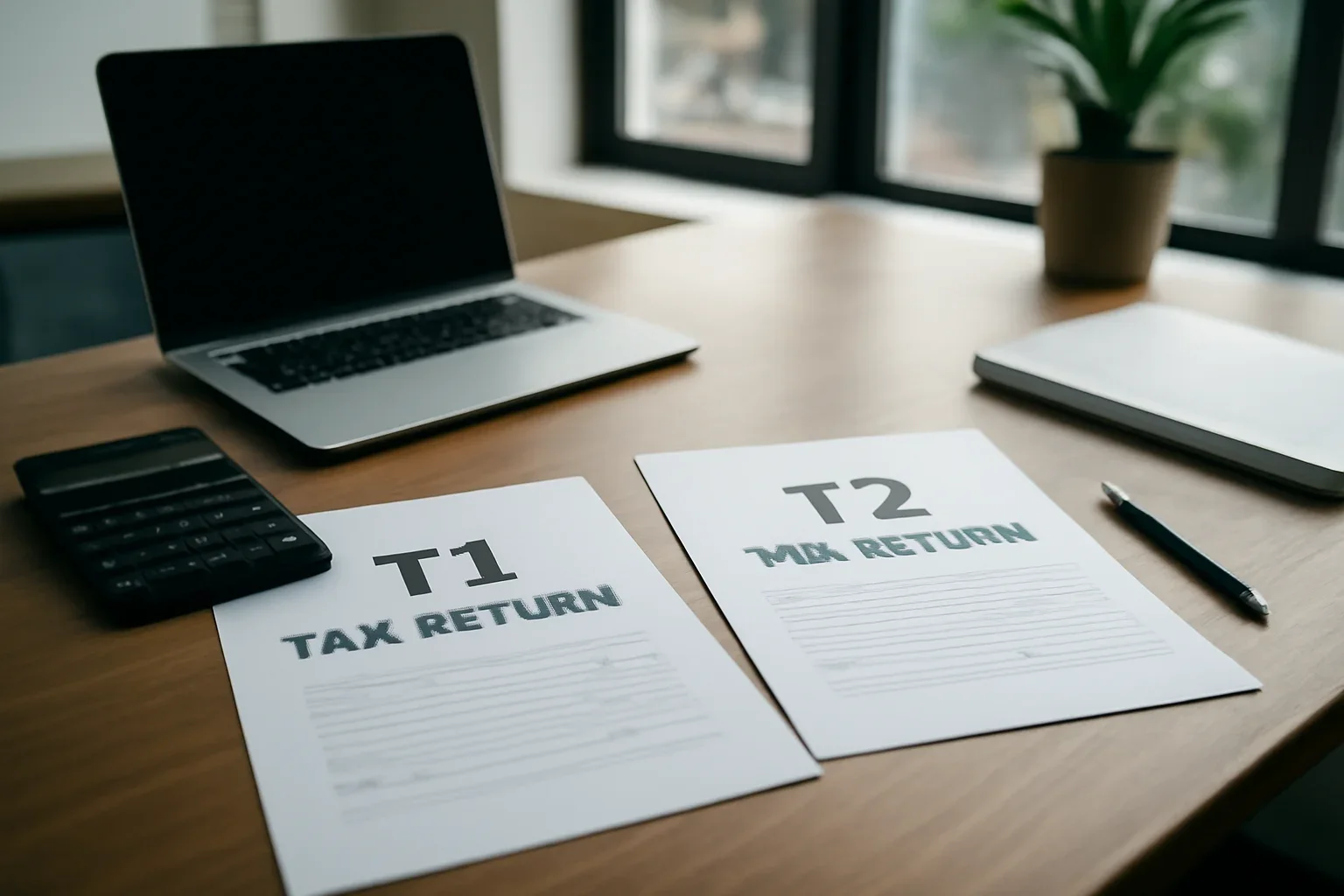
The Simplest Distinction Is Individual Versus Corporation
A lot of tax confusion starts because people know they need to file their taxes but are not sure which form applies to their setup. The simplest way to understand the difference is that a T1 return is for an individual person, while a T2 return is strictly for an incorporated company. This distinction sounds easy, but things get tricky when an individual runs an unincorporated small business.
If you operate your company as a sole proprietor or independent contractor, the Canada Revenue Agency (CRA) does not separate you from your business. Because you are the exact same legal entity, you will use a T1 return to report both your personal life and your business numbers together. For a look at when your growing business should consider shifting models, review our full guide on whether you Should You Incorporate Your Business in BC.
- T1 Context: Used by individuals, employees, sole proprietors, and self-employed professionals.
- T2 Context: Used exclusively by legally incorporated business entities.
- Filing Mistake Risk: Submitting the wrong documents triggers massive structural delays and immediate CRA corrections.
- Entity Status: Corporations are viewed as distinct legal people and always file their paperwork separately from their founders.
T1 Return Overview (Personal, Sole Proprietor, Self-Employed)
The T1 Income Tax and Benefit Return is the standard tax document that almost every single Canadian resident files each year. It is designed to summarize your entire personal financial landscape over a single calendar year. If you work a normal job, your employer tracks your earnings and sends you a T4 slip, which you copy directly onto your T1 form.
For self-employed individuals and sole proprietors, the T1 process includes an extra form called the T2125 Statement of Business or Professional Activities. You use this special schedule to list your gross commercial revenue and subtract your eligible operating expenses. Your remaining net business profit is then added to your other personal income streams, like investment returns or employment income, to calculate your final personal tax balance.
T2 Return Overview (Corporations Only)
The T2 Corporation Income Tax Return is a completely separate document meant exclusively for incorporated entities. Whether your corporation is an active local store, a passive holding company, or a non-profit organization, it must file a T2 return every single fiscal year. This rule applies even if your company did not make any money or remained completely inactive during the period.
A T2 return is far more advanced than an individual filing. It does not just look at your raw income and receipts; it requires a full reporting of your company's balance sheet, including corporate assets, liabilities, shareholder equity, and retained earnings. To gain a deep understanding of what this major filing package includes, look over our detailed article on What is a T2 Corporate Tax Return.
Who Files a T1 Tax Form?
You must file a T1 tax return if you earned personal income in Canada or need to claim regular government benefit credits. This pathway applies to the vast majority of people across the province. If you run an unincorporated side hustle, deliver food on a contract basis, or manage a freelance consulting firm, you belong strictly in the T1 category.
In this framework, your business net income combines directly with your personal revenue lines. This means your total income is subject to standard progressive personal tax rates. If your self-employed business makes a high profit, that income can easily push you into the highest personal tax brackets, where the government collects over half of your top-tier earnings.
Who Files a T2 Tax Form?
You must file a T2 tax return if your business is registered as a legal corporation. The moment you complete your provincial or federal incorporation paperwork and receive a Certificate of Incorporation, your business enters the corporate tax system. It must now manage its own unique business number and tax filings entirely separate from your personal life.
This structure means your corporate revenue is taxed at flat corporate rates rather than progressive personal brackets. For eligible small businesses in British Columbia, this combined rate is a low 11 percent on the first $500,000 of active profits. This low rate is a massive advantage, but it requires you to respect the boundary between your personal wallet and the corporate bank account.
Filing Deadlines: A Critical Separation
One of the easiest ways to get into trouble with the CRA is to mix up your filing and payment deadlines. The calendars for T1 and T2 filings operate on completely different logic and schedules.
| Return Type | Filing Due Date | Tax Payment Due Date |
|---|---|---|
| Standard Individual (T1) | April 30 | April 30 |
| Self-Employed / Sole Proprietor (T1) | June 15 | April 30 |
| Incorporated Business (T2) | 6 months after fiscal year-end | 2 to 3 months after fiscal year-end |
As you can see, self-employed individuals get until June 15 to submit their T1 paperwork, but any cash they owe the government must still be paid by April 30. For corporations, your dates depend entirely on your chosen fiscal year-end. If your company closes its books on September 30, your T2 return is due by March 31, but your actual tax cash payment is typically due by December 31 or January 31.
Deductions Available in Each Structure
The write-offs and deductions you can claim vary substantially between personal and corporate returns. On a T1 return, you can claim personal tax credits like medical expenses, charitable donations, child care costs, and tuition balances. If you file a T2125 schedule as a sole proprietor, you can also write off business-specific items like commercial tools, home office workspace, and work-related vehicle mileage.
On a T2 corporate return, personal credits do not exist. A corporation can only deduct legitimate, active business expenses incurred to generate commercial income. However, corporations have access to advanced tax mechanisms, such as capital cost allowances, loss carry-back structures, and special deductions for share setups.
Penalties for Late Filing by Form Type
Missing your filing deadlines results in automatic, compounding penalties from the CRA. For a T1 return with a balance owing, the late-filing penalty starts at an immediate 5 percent of your unpaid tax bill. The government then adds an extra 1 percent for every full month your return remains late, up to a maximum of 12 months.
For a T2 corporate return, the late-filing penalty is also 5 percent of the unpaid tax amount, plus an extra 1 percent per month for up to 12 months. However, if the CRA catches your corporation filing late multiple times over a three-year window, the initial penalty jumps to 10 percent, and the monthly addition climbs to 2 percent for up to 20 months. These heavy fines can easily drain thousands of dollars from your corporate cash reserves.
T1 General vs. T2 Corporate Complexity
The complexity of a T1 personal return is generally manageable. Most individuals can complete a basic T1 using standard commercial tax software. Even with a self-employed business schedule added, the return is still focused entirely on tracking cash inflows and outflows over a basic 12-month calendar.
A T2 corporate return is a completely different story. It requires a deep understanding of corporate tax law and professional accounting standards. You must translate your standard business bookkeeping into specific General Index of Financial Information (GIFI) codes. Reconciling your net business profit on your financial statements with your actual taxable corporate income requires advanced adjustments that are highly prone to errors if done without training.
Income Sources Reported on Each Form
A T1 return is designed to hold a wide variety of personal income categories. It includes your worldwide employment wages, investment dividends, rental properties, capital gains from selling stock, and retirement pensions. It represents your entire financial life wrapped into one single file.
A T2 return focuses strictly on corporate earnings. This includes active commercial revenue from selling products or services, corporate investment gains, and rental income earned by the company. It never includes your personal wages or your private investments, as those must be paid out to you through T4 or T5 slips and reported on your personal T1 form.
Estimated Tax Payments and Holdbacks
Both individuals and corporations must pay their taxes throughout the year if their annual bills cross a specific threshold. For self-employed individuals filing a T1, if your net tax owing crosses $3,000 for two years in a row, the CRA will require you to pay your taxes via quarterly installments in March, June, September, and December.
Corporations face a similar but stricter requirement. Most active corporations must pay their estimated income taxes in monthly installments rather than quarterly chunks. These payments are due within 15 days of the end of each single month. Failing to budget for these ongoing payments can leave your corporation with unexpected interest penalties at year-end.
Professional Help Considerations
While a sole proprietor might comfortably manage their own basic T1 tracking early on, running an incorporated business without expert accounting support is highly risky. Navigating corporate capital structures, share classes, shareholder loans, and GIFI mapping requires specialized knowledge.
Hiring an experienced professional ensures your corporate entity stays completely compliant with all provincial and federal rules while maximizing your deductions. To determine whether your business structure requires an expert hand to handle these complex corporate forms safely, explore our analytical guide on Do You Need a CPA to File Corporate Taxes in Canada.
Frequently Asked Questions
Can I file a T2 return myself using regular personal tax software?
No. Standard personal tax software only supports T1 returns. Corporate T2 returns require specialized corporate tax software that supports GIFI data mapping and electronic corporate filing links.
If my corporation lost money this year, do I still need to file a T2 return?
Yes. Every incorporated business in Canada must file a T2 return every single year, regardless of whether it generated a profit, suffered a loss, or remained entirely inactive.
How do I report the money I took out of my corporation on my T1 return?
Any funds you withdraw from your corporation must be officially classified as employee salary or shareholder dividends. The company will issue you a T4 or T5 slip, which you then report as personal income on your T1 return.
Areas We Serve
Phoenix Knight Financial Solutions offers elite personal tax preparation, corporate T2 filing, and proactive small business accounting services across British Columbia using our custom white card grid framework.