Plan Before Spending
Review the business model and expected costs before making larger financial commitments.
- Business idea review
- Launch-cost estimate
- Revenue assumptions
- Cash-needs discussion

Startup Business Advisory in Surrey BC helps founders who have a strong idea but are unsure what to do first. You may be worried about choosing the wrong structure, spending too much before revenue starts, underpricing your offer, missing tax setup, or asking for financing without a clear plan.
Phoenix Knight Financial Services helps turn those early questions into next steps. We review launch costs, business structure, registration needs, pricing, cash flow, accounting setup, funding preparation, tax readiness, payroll planning, and first-year reporting so you can understand what needs attention before you commit more money, sign contracts, or hire staff.

A new business needs more than an idea. It needs a workable structure, realistic costs, clear pricing, organized records, and enough cash to reach the first stages of regular revenue.
Review the business model and expected costs before making larger financial commitments.
Organize the structure, accounting workflow, banking records, invoices, receipts, and tax-related accounts needed for launch.
Build a routine for reviewing revenue, spending, cash, bookkeeping, taxes, and the decisions that follow launch.
Bring your idea, rough numbers, questions, early sales records, or launch-cost estimates. The first step is organizing what you already know and identifying what still needs research or review.
Before buying equipment, signing a lease, or taking on other fixed costs, review the assumptions behind the idea. A useful startup plan should explain who the customer is, what they need, how the business earns revenue, and what it costs to deliver.

A useful business plan should explain the offer, customer, operating model, startup costs, expected revenue, ongoing expenses, and cash needs without becoming unnecessarily complex.
Define what the business sells, who it serves, how the work is delivered, and how revenue is earned.
Organize the competition, customer-acquisition approach, positioning, and early sales assumptions.
Map the people, systems, tools, suppliers, and workflow needed to deliver the offer.
Estimate startup costs, expected revenue, recurring expenses, cash timing, and the amount of outside funding that may be required.
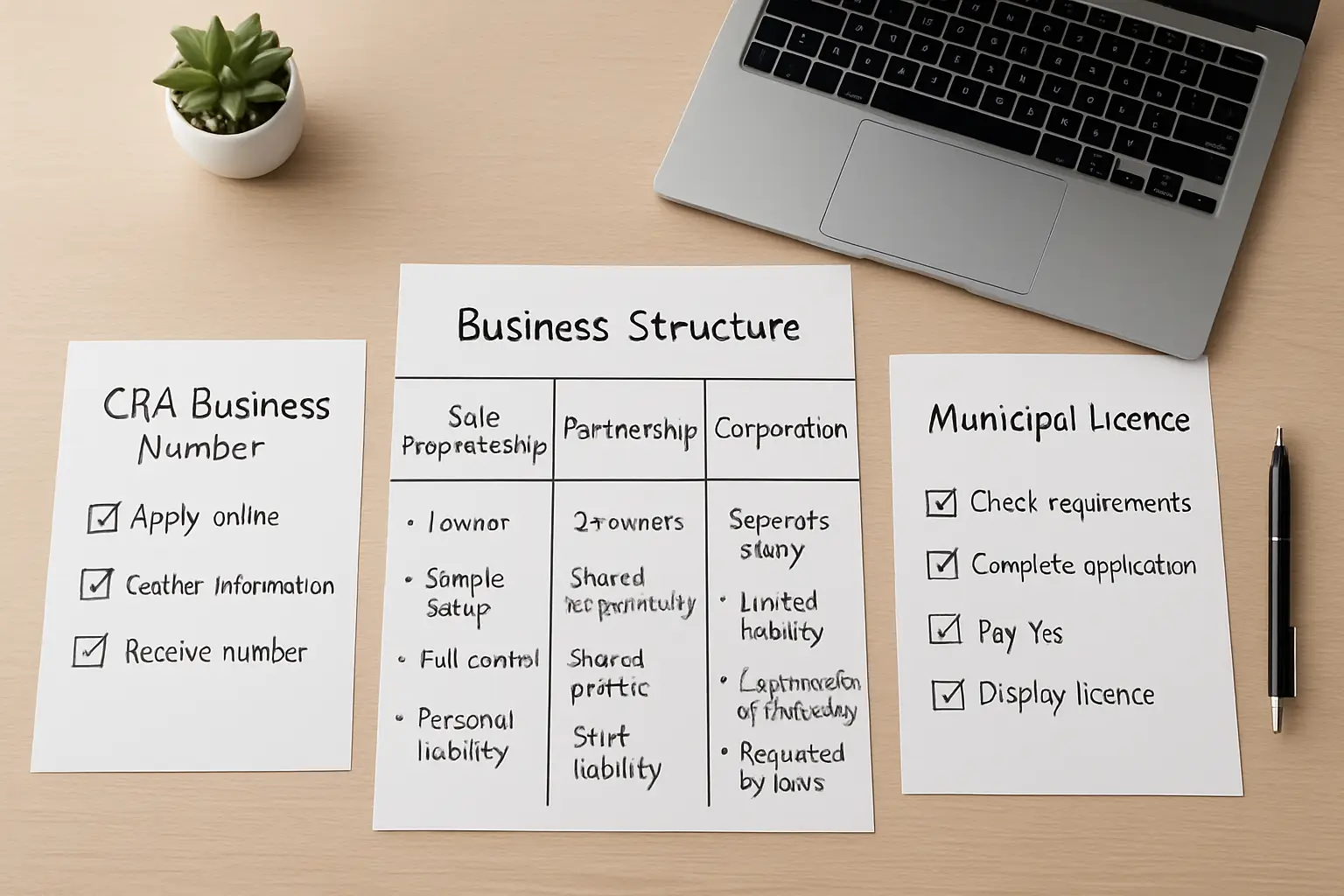
A sole proprietorship, partnership, and corporation can create different tax, administration, ownership, financing, and legal considerations. The right choice depends on the business rather than a single rule that applies to every startup.
Early accounting setup creates a place for startup costs, owner contributions, customer invoices, expenses, receipts, GST/HST information, and future financial reports.

A launch budget should separate one-time startup costs from recurring monthly costs and identify how much cash may be needed while revenue is still developing.
Costs that may occur before or around the start of operations.
Expenses that continue even while customer volume is still developing.
Consider how the business will meet obligations if sales build more slowly or customer payments arrive later than expected.

Revenue and cash do not always arrive at the same time. A startup forecast can map expected receipts against expenses and show when the business may need additional working capital.
Forecasts are planning estimates, not guarantees. Financing, loans, grants, or other funding remain subject to the eligibility rules and decisions of the relevant lender or program.
Explore Cash Flow ForecastingStartup expenses, owner-paid costs, equipment, sales, GST/HST information, payroll records, and other transactions can become harder to reconstruct when they are not organized as they happen.
Keep supporting records for costs incurred while the business is being set up and operated.
Track business costs paid personally so the accounting records can explain how the owner funded early activity.
Organize sales, purchases, tax codes, supporting documents, and registration information as the business develops.
Explore GST/HST Filing ServicesA startup can generate sales and still struggle if pricing does not cover delivery costs, overhead, owner time, and other expenses. Early tracking can show which assumptions need review.
Decide how much the startup can spend testing customer acquisition without ignoring the effect on cash.
Record where leads and sales come from so early marketing decisions can be compared with actual customer activity.
Hiring adds payroll records, cash commitments, worker information, remittance responsibilities, and recurring administrative work. Planning those records before the first payroll can make the process easier to maintain.

The questions change after the business moves from planning and launch into regular operations. Startup advisory focuses on building the initial financial foundation, while ongoing advisory focuses more on performance and growth decisions.
Small setup issues can become harder to correct after transaction volume, customer activity, hiring, and tax responsibilities grow.
Startup costs and accounting records differ depending on how the business earns revenue, buys materials, pays workers, manages inventory, or bills customers.
Planning may involve tools, vehicles, materials, subcontractor records, project costs, deposits, and payroll.
Explore Contractor Accounting ServicesPlanning may involve inventory, supplier costs, payment systems, rent, staffing, margins, and daily sales records.
Planning may involve contracts, client billing, software, insurance, professional costs, retainers, and recurring revenue.
Planning may involve equipment, clinic expenses, staff, practitioner payments, software, and financial reporting.
Explore Healthcare AccountingPlanning may involve subscriptions, contractor costs, project billing, online revenue, software, and remote workflows.
Planning may involve commission records, marketing, vehicle costs, referral fees, software, and transaction records.
Explore Real Estate AccountingA startup timeline helps separate decisions that need attention before launch from those that depend on actual customer and financial results.
Review the business model, structure, startup budget, customer assumptions, and initial cash needs.
Organize registration, banking, accounting, receipts, invoices, tax records, and operating systems.
Begin serving customers while tracking sales, costs, cash flow, pricing, and unresolved workflow issues.
Compare actual results with the original assumptions and decide what should be adjusted before scaling further.
Some founders need help with one decision. Others need several parts of the financial setup reviewed together before launch.
A founder with an early idea needs different support from a business that already has customers and transactions.
Partners, corporations, hiring, and financing plans can add more questions to the initial setup.
Funding discussions may require more detailed launch costs, financial assumptions, and cash-flow projections.
Businesses with more transactions, staff, suppliers, or payment systems may need a more detailed accounting workflow.
Once transactions become regular, recurring bookkeeping can keep bank activity, receipts, expenses, invoices, and financial reports organized.
Explore Bookkeeping ServicesPhoenix Knight supports Surrey founders with business planning, startup budgets, structure questions, accounting setup, cash-flow planning, funding preparation, tax records, payroll planning, and first-year financial decisions.
Explore the Surrey Service AreaFind direct answers about startup planning, business structure, budgets, accounting setup, funding preparation, bookkeeping, and first-year financial records.
Startup advisory can include business planning, structure questions, registration planning, launch budgeting, accounting setup, pricing, cash-flow forecasting, funding preparation, tax readiness, payroll planning, and first-year reporting. The exact work depends on the founder's stage and priorities.
No single structure is right for every startup. The decision can depend on expected income, ownership, administrative requirements, financing plans, liability considerations, and longer-term goals. Legal questions should also be reviewed with an appropriate legal professional where needed.
A startup budget can separate one-time launch costs, recurring operating costs, owner cash needs, tax obligations, debt payments, and a cash reserve. The assumptions should be revisited as actual costs and sales become available.
Phoenix Knight can help organize an accounting system, chart of accounts, bank and card connections, receipts, invoices, startup cost records, tax-related information, and a recurring financial review process.
Startup advisory can help organize launch costs, revenue assumptions, expense projections, cash-flow forecasts, funding needs, and other financial information for financing discussions. Approval and eligibility remain the decision of the lender or funding program.
Early transactions can include registration costs, equipment, software, professional fees, deposits, owner contributions, and other startup spending. Recording those transactions as they happen can make later accounting and tax preparation easier to organize.
Once the business has regular activity, the focus can shift toward monthly bookkeeping, actual-versus-budget results, cash-flow monitoring, tax planning, hiring decisions, and broader business advisory.
Yes. Phoenix Knight provides startup business advisory support for entrepreneurs in Surrey, British Columbia.
Review broader service options, first-year tax support, or a practical startup bookkeeping resource as the business moves from planning into regular operations.
Tell Phoenix Knight what stage you are at and what is creating the most uncertainty—business structure, startup costs, accounting setup, pricing, cash flow, financing preparation, tax records, or hiring.
Start with the notes, numbers, business plan, estimates, or early records you already have. The initial review can identify what needs attention before the next commitment is made.
Contact Phoenix Knight